

Invasive Lobular Carcinoma of the Breast
Lobular carcinoma originates in the breast '
This type of cancer comprises only around 10% of all breast cancers, but the incidence rate is thought to be increasing, especially amongst postmenopausal women.
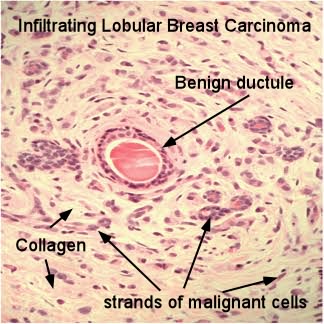
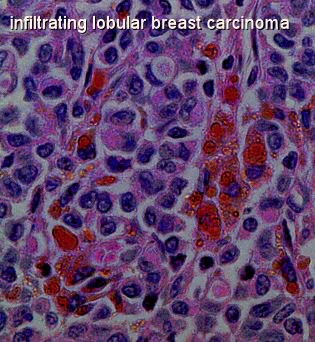
In cytological appearance, the 'classic' presentation of infiltrating lobular cancer shows relatively uniform cells with grade I cytologist features.
Upon infiltration, the cellular pattern often appears as rows of cells scattered randomly, but no more than one or two cells wide. Sometimes it forms in 'target-like' or concentric patterns around ducts.
I just want to let you know that we have a newer version of this page, with more up-to-date information on infiltrating lobular carcinomas. However, this page is still pretty good for research.


There are several 'subtypes'
Common sub-types of infiltrating lobular cancer include the:-
- pleomorphic variant (with larger, more atypical nuclei)
- alveolar variant (with rounded groups of cells)
- solid variant (with groups of tubercular "rods" of malignant cells less than 2 cells thick)
- signet ring variant (with 'ringlet' cells but with a 'wall' only one or 2 cells thick)
Invasive Lobular Breast Cancer Diagnosis
Infiltrating lobular cancer can be hard to spot on a mammogram, sometimes impossible.
This type of cancer typically does not create a substantial reaction in connective tissues, nor destroy other anatomical structures. It is also uncommon to form a distinct, palpable mass.
Instead, it usually constitutes a somewhat vague thickening of the breast tissue.


IF it is noticed on a mammogram, lobular cancer looks a lot like ductal carcinoma. It often shows as a vaguely defined mass with fine spikes radiating from the edges (a 'spiculated' pattern).
Lobular carcinoma is also slightly more likely than ductal carcinoma to be multifocal or bilateral, but in terms of survival rates there is virtually no difference between the two.
Treatment
The treatment for confirmed cases is by mastectomy and this occurs slightly more frequently than with ductal carcinoma.
However, if a surgeon can obtain clear surgical margins breast-conserving surgery has proven to be a good option.
Invasive lobular cancer also tends to be hormone receptor-positive, so adjuvant endocrine therapies are a little more common. For some reason, many of these infiltrating cancers are less responsive to endocrine therapy than expected, but this has not proven to have any consistent bearing on survival rates.
A more in-depth page on treatments targeted at hormone sensitive tumors is much newer.
Here are some common Q&A's ...
What does infiltrating lobular carcinoma look like?
It does not typically form a lump as most women expect with breast cancer. Instead, it often causes a thickening of the tissue or fullness in one part of the breast.
What are the symptoms?
At it's earliest stages, invasive lobular carcinoma may cause no signs or symptoms.
As it grows larger, however, it may cause:-
- an area of thickening in part of the breast
- a new area of fullness or swelling in the breast
- a change in the texture or appearance of the skin over the breast (such as dimpling or thickening)
- an inverted nipple.
When should I see a doctor?
Make an appointment with your doctor if you are experiencing any signs or symptoms that worry you. Your doctor may recommend beginning screening mammograms or other tests at an earlier stage.
What are the Causes?
Researchers are not entirely clear on what causes lobular carcinoma
How does infiltrating lobular carcinoma form?
Invasive lobular carcinoma begins to form when cells in one or more milk-producing glands of the breast develop mutations in their DNA. The mutations tell the cells to divide and grow rapidly. The cancer cells can spread to other areas of the body.
Infiltrating lobular carcinoma (or invasive lobular carcinoma) tends to invade surrounding breast tissue in a web-like manner. The affected area may have a different feel from surrounding breast tissue, but it is unlikely to feel like a lump.
What are the known risk factors?
Some factors that may increase your risk of infiltrating lobular carcinoma may include:-
- being female
- older age
- lobular carcinoma in situ (LCIS)
- post-menopausal hormone use (HRT treatments)
- inherited genetic cancer syndromes
Are there any known complications?
Cancer in the other breast, as well as cancer that spreads to other areas of the body, are some complications people may have.
What are the tests & diagnosis?
- Mammogram
- ultrasound
- MRI
- Biopsy (removing a sample of tissue for further testing)
What is the treatment for invasive lobular carcinoma?
- Surgery
- chemotherapy
- radiation therapy
- hormone therapy
Are there any alternative medicines?
No alternative medicine treatments can cure breast cancer. Instead, complementary and alternative treatments are most helpful for coping with the side effects of cancer and cancer treatment.
Options may include
- hypnosis
- meditation
- relaxation exercises
- yoga
Studies show that some of the above complementary treatments are very helpful to breast cancer survivors.
What could I do for coping and support?
A diagnosis of breast cancer may be one of the most difficult situations you'll ever face. It can set off a rollercoaster of emotions, shock and fear to anger, anxiety or depression. With time, you will find your own way of coping with your feelings. Until then, you may find comfort if you learn enough about your cancer to:-
- make treatment decisions
- seek support from your family and friends
- connect with other cancer survivors
- take care of yourself (get enough sleep, choose a diet full of fruits and vegetables, stay physically active and take time to relax).
How can I prevent infiltrating lobular carcinoma?
To reduce the risk of breast cancer consider trying to:-
- discuss the benefits and risks of hormone therapy with your doctor
- drink alcohol in moderation if at all
- exercise most days of the week
- maintain a healthy weight
For a full discussion on risk factors for breast cancer see our new post HERE
Further Reading
- Types of Invasive Lobular Carcinoma
- Lobular Carcinoma In-Situ and Invasive Lobular Carcinoma
- Ductal Carcinoma In-Situ and Lobular Carcinoma In-Situ
- Lobular Carcinoma In-Situ (LCIS)
- Index of ALL our Articles on Types of Breast Cancer
- Index of ALL our Articles on Breast Cancer Incidence and Survival Rates
- Articles about Breast Cancer Treatment
Return to Homepage
References
- Arpino G, Bardou VJ, Clark GM, Elledge RM. (2004) Infiltrating Lobular Carcinoma of the Breast: Tumor Characteristics and Clinical Outcome. Breast Cancer Research. 2004;6(3) https://www.ncbi.nlm.nih.gov/pmc/articles/PMC400666/
- Martinez V, Azzopardi JG. (1979) Invasive lobular carcinoma of the breast: incidence and variants. Histopathology. 1979 Nov;3(6):467-88 https://www.ncbi.nlm.nih.gov/pubmed/229072
- Singletary SE, Patel-Parekh L, Bland, KI. (2005) Treatment Trends in Early-Stage Invasive Lobular Carcinoma. Ann Surg. (August 2005) ; 242(2): 281–289. https://www.ncbi.nlm.nih.gov/pmc/articles/PMC1357735/
- Smith DB, Howell A, Wagstaff J. (1987) Infiltrating lobular carcinoma of the breast: Response to endocrine therapy and survival. European Journal of Cancer and Clinical Oncology (July 1987) Volume 23, Issue 7, Pages 979-982 https://www.ncbi.nlm.nih.gov/pubmed/2822427
- Sneige N, Wang J, Baker BA, Krishnamurthy S, Middleton LP. (2002) Clinical, histopathologic, and biologic features of pleomorphic lobular (ductal-lobular) carcinoma in situ of the breast: a report of 24 cases. Mod Pathol. 2002 Oct;15(10):1044-50. https://www.ncbi.nlm.nih.gov/pubmed/12379750
- Weinstein SP, Orel SG, Heller R. (et al). (2001) MR imaging of the breast in patients with invasive lobular carcinoma. AJR Am J Roentgenol. 2001;176:399–406. https://www.ncbi.nlm.nih.gov/pubmed/11159081
- Wheeler DT, Tai LH, Bratthauer GL, Waldner DL, Tavassoli FA. (2004) Tubulolobular carcinoma of the breast: an analysis of 27 cases of a tumor with a hybrid morphology and immunoprofile. Am J Surg Pathol. 2004 Dec;28(12):1587-93 https://www.ncbi.nlm.nih.gov/pubmed/15577677
- Yeatman TJ, Cantor AB, Smith TJ. (et al). Tumor biology of infiltrating lobular carcinoma: implications for management. Ann Surg. 1995;222:549–561 https://www.ncbi.nlm.nih.gov/pubmed/7574934